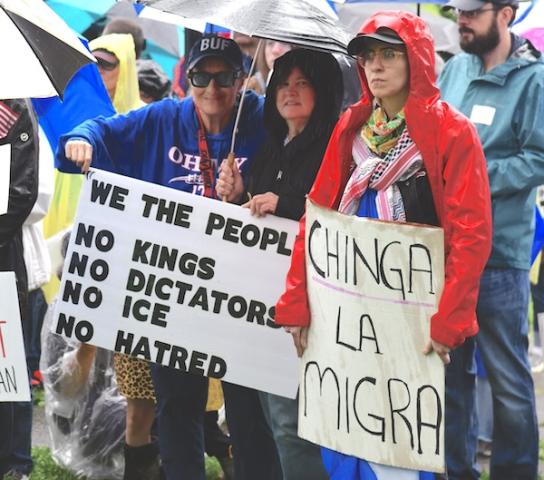
No Kings Protest in Jamestown, NY Photo: Langellephoto.org (2025)
The climate catastrophe isn’t something waiting in the future.
It’s already happening—and it is reshaping who gets to live safely, who is forced to move, and how governments choose to respond.
As droughts, floods, fires, hunger, and economic collapse intensify around the world, more people are being pushed from their homes. Climate disruption is driving mass displacement on a scale humanity has never seen. And rather than preparing to respond with cooperation, and justice, powerful nations are increasingly meeting this reality with walls, weapons, and repression.
In the United States, that response has taken the shape of an ICE storm.
In Minneapolis and cities and towns across the country, federal immigration ICE agents—masked, heavily armed, often unidentified—are violently rounding up people labeled “illegal.” In the process, they violate basic rights, intimidate families, terrify communities, and use force against anyone who gets in the way, citizen or not.
Trump’s re-envisioned ICE agents move like an occupying army, overwhelming communities with thousands of masked agents in unmarked vehicles, committing abductions with what appears to be indiscriminate violence designed to intimidate. They will kill. This is a de facto military force unleashed on a civilian population.
The vast majority of people being targeted are not criminals or threats. They are the same people this country relies on every day—keeping food on tables, caring for children and elders and holding together essential systems in jobs many don’t want and that have few protections. In an economy already strained by extreme inequality, climate disruption, and systemic instability, migrants become convenient scapegoats.
Over the past year, President Trump’s administration has deported approximately 230,000 people arrested inside the country and another 270,000 at the border, a New York Times analysis of federal data shows.
This is most clearly a human catastrophe, but around the world conflicts regarding migration due to climate disruption were predicted long ago.
Governments, corporations, and military planners have known for decades what we were headed for. They knew that endless growth on a finite planet would lead to instability. The Pentagon itself warned back in 2004 that “climate change could bring the planet to the edge of anarchy as countries … defend and secure dwindling food, water and energy supplies.” They knew it but did not act.
The Stanford Doerr School of Sustainability estimates by 2050 1.2 billion people could be displaced globally due to the rise in extreme weather and natural disasters. Climate change is both increasing the number of people who are forced to leave and the number of people who are forced to stay where they are.
Why? Because the system we live under rewards unlimited profit and expansion, at any cost.
Land, water, forests, and minerals aren’t treated as shared basics of life. They’re treated as assets — things to be taken, fenced off, and sold. Around the world, communities are pushed off their land in the name of development or security. Even carbon is a commodity, leading to more land grabs to allow major polluters to keep operating under the guise of climate mitigation. What’s being taken isn’t just money or material. It’s literally the possibility of a livable future.
Governments know resources are under strain and that more people are being forced from their homes by drought, hunger, flooding, earthquakes, war/conflict, and economic circumstances. But instead of responding with help, many choose to protect wealth and power. Borders harden. Surveillance grows. Refugees increase. According to the NGO Concern Worldwide US, one person is uprooted every two seconds.
Many people are fleeing regimes armed, supported, or propped up by the same global powers now shutting their doors. They’re left stuck between collapsing states, climate devastation, and sealed borders, with nowhere safe to go. History shows what can happen when scarcity is managed through fear and blame. When people are treated as disposable. Large-scale violence becomes possible. Genocide is not just a tragedy of the past — it’s what emerges when humans are scapegoated, when their lives are stripped of value.
At the same time, working people are pushed to compete with one another for jobs with less security and fewer benefits in an unstable economy. Instead of asking why their conditions keep getting worse while billionaires get richer, people are encouraged to blame immigrants, the poor, or “others” with less protection.
Media and political messaging become propaganda to direct and shape this blame. Facts become opinions. Lies become truths simply because they’re everywhere. Nazi propagandist Joseph Goebbels’ strategy to “repeat a lie often enough and it becomes the truth” has become standard operating procedure among the powerful. History is simplified or erased. The present is turned into constant noise. The future is framed as something ordinary people have no control over.
Entertainment fills the space where understanding and conversation should be. News, advertising, outrage, and distraction blend together. People are overloaded with misinformation. The result is exhaustion, division, and misplaced anger.
But this is not inevitable.
Being alive still means having choices. As Jean-Paul Sartre argued, to exist is to be free—and freedom includes the ability to say no. Saying no means refusing lies, rejecting the idea that things ‘have to be this way,’ and pushing back against systems that thrive on our resignation – the complicity of our silence.
Saying no is not denial. Saying no is choosing to be free. It is the beginning of taking power back.
The next step is choosing to stand with others — to protect what matters. Your family. A threatened forest. People being attacked by masked lawless vigilantes posing as federal agents. Communities in distant places whose lands are being stolen. There is real strength in acting together– to refuse greed, defend life, and to stand up to violence and intimidation.
In saying No More.
That’s how power is rebuilt, when we say no together.
That’s how resistance becomes freedom.
Global Justice Ecology Project stands with the people in Minneapolis and everywhere around the world where communities are resisting injustice and taking back their power.
“The most common way people give up their power is by thinking they don’t have any.” — Alice Walker
Listen to our latest Breaking Green podcast on people’s response to the ICE surge in Minneapolis with Mark Tilsen of Indigenous Environmental Network