
The U.S. and Israel have now killed more than 1,000 Iranian people. CENTCOM reports hitting 2,000 targets, and War Secretary Pete Hegseth announces sinking an Iranian submarine. Israel says it struck the Assembly of Experts, though Iran says the building was not being used at the time. Iranian drones hit central Israel, Gulf countries, and U.S. targets, including the consulate and CIA station in Saudi Arabia and a THAAD missile interception radar system. NATO shoots down missile headed toward Turkey. UAE and Qatar deny role in attacks on Iran. The U.S. will cover shipping losses in the Gulf, President Donald Trump says. U.S. weighing plan to arm Kurdish forces against Iran. Israel orders mass displacement of all of southern Lebanon. Hezbollah declares “open war.” Raids across the occupied West Bank. James Talarico wins Texas Democratic Senate primary against Rep. Jasmine Crocket. Roy Cooper and Michael Whatley win primaries in pivotal North Carolina Senate race. Nida Allam seeks recount in North Carolina Democratic primary. Homeland Security Secretary Kristi Noem defends immigration crackdown at Senate hearing. U.S. reportedly prepares draft indictment against Venezuelan President Delcy Rodríguez. U.S. launches military operations against “narco-trafficking” with Ecuador. Cuban tanker cleared to load LPG in Venezuela. Pakistan-Afghanistan war continues as civilian deaths rise. West African bloc plans activation of regional standby force to fight armed groups.
Leqaa Kordia, a 33-year-old Palestinian woman from Paterson, New Jersey, has spent nearly a year in ICE detention in Texas after speaking out against Israel’s war in Gaza, despite an immigration judge twice ruling that she is eligible for release. Drop Site joins the IMEU Policy Project, MPower Action, Jewish Voice for Peace ACT, and the US Campaign for Palestinian Rights Action in calling for her immediate release. The link below allows users to send emails and make calls to your member of Congress on Leqaa’s behalf:
This is Drop Site Daily, our free daily news recap. We send it Monday through Friday.
War on Iran
-
U.S. and Israeli airstrikes pound Iran for a fifth day, killing civilians: The U.S.-Israeli war on Iran has entered its fifth day with new waves of intense bombing targeting Tehran and other areas. U.S. Central Command (CENTCOM) said it has struck nearly 2,000 targets since Saturday. In the past 24 hours, the IRGC has recorded 104 attacks across 19 of the country’s provinces, with strikes hitting military bases, medical centers, and residential areas. A statement from the Islamic Revolutionary Guard Corps detailed several incidents from yesterday’s strikes. A U.S. Tomahawk missile struck a residential home in Oshnavieh County, killing an entire family; an air-launched missile hit a private car in Salman County, killing five; and a missile strike in the Qasemiyeh neighborhood of Urmia killed an elderly couple. The statement also reported strikes on residential homes and a wedding hall in Kangavar County. The IRGC warned that “none of these crimes and innocent massacres will go unanswered.”
-
Casualty counts: The death toll in Iran has reached 1,045 people, according to the official Foundation of Martyrs and Veterans Affairs, state media reported. The foundation said the death toll represented the number of bodies that have been identified and prepared for burial.
-
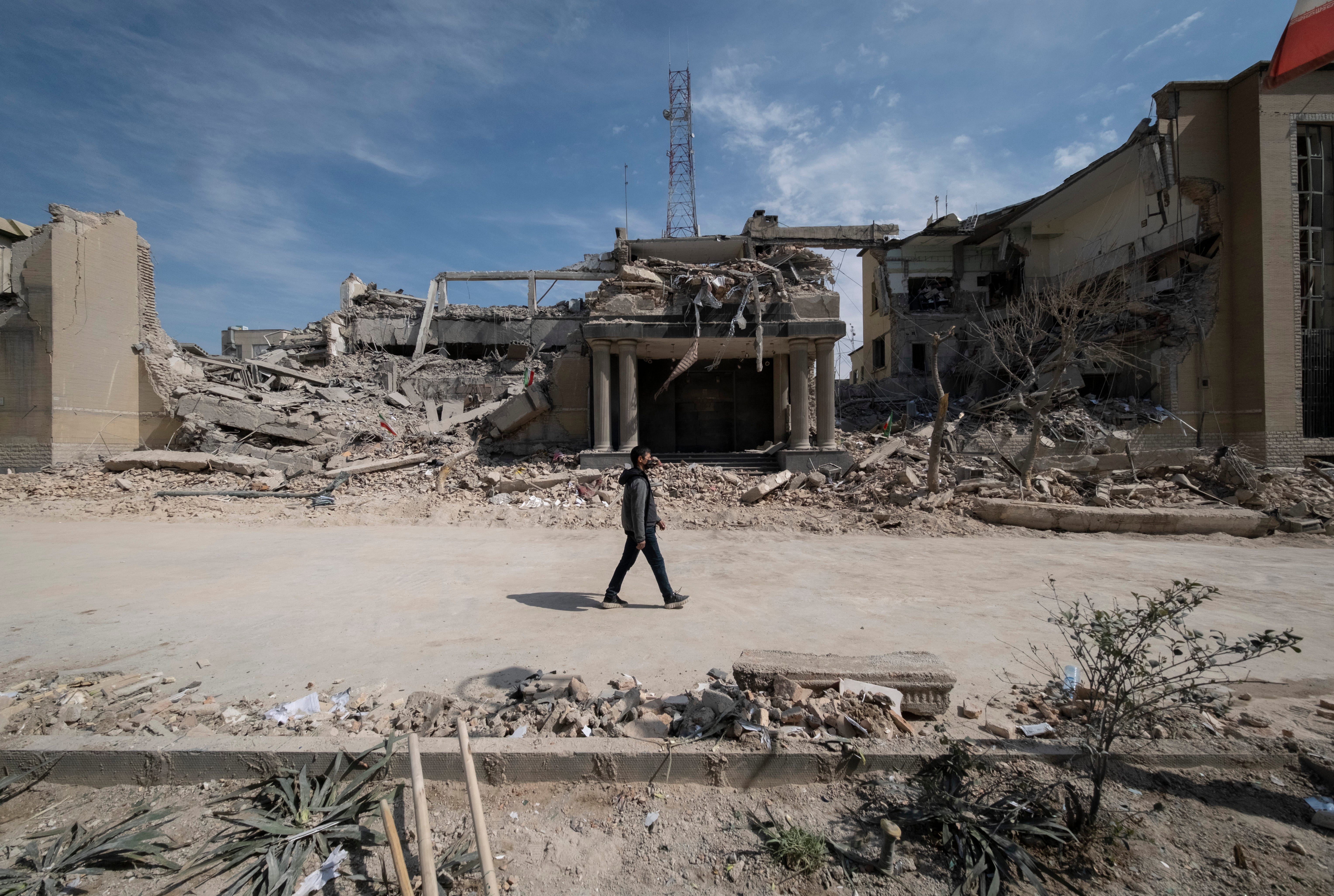
Israel says it struck the Assembly of Experts: Israel carried out strikes in Qom on Tuesday, hitting a building associated with the Assembly of Experts, the body responsible for appointing Iran’s Supreme Leader. There are disputed accounts over whether the strike actually hit the Assembly as it conducted its business. American and Israeli sources have been reported in the media as saying the strike interrupted an active vote to replace the assassinated Ayatollah Ali Khamenei, and Iranian sources calling such reporting “completely false” and part of psychological operations conducted against the country.
-
Israel threatens to kill Khamenei’s successor: Israeli defense minister Israel Katz on Wednesday threatened to assassinate whoever is selected to be the next supreme leader of Iran. “Every leader appointed by the Iranian terror regime to continue and lead the plan to destroy Israel, to threaten the United States and the free world and the countries of the region, and to suppress the Iranian people—will be a target for elimination,” Katz wrote.
-
Khamenei funeral ceremony postponed: The funeral ceremony for Supreme Leader Ayatollah Ali Khamenei, who was assassinated by Israel in one of the early strikes of the war, originally scheduled to start at 10 p.m. tonight, has been postponed, according to Iran’s Tasnim news agency. Officials had planned three nights of public mourning with the casket containing Khamenei’s body at the Grand Mosalla in Tehran.
-
Israel issues evacuation warnings inside Iran: The Israeli military posted Farsi-language evacuation orders on Tuesday for residents near Tehran’s Hakimiyeh industrial zone and Payam Airport in Karaj, publishing maps marking areas it said were designated for strikes.
-
War Secretary Pete Hegseth said “more forces are arriving” in the Middle East: Speaking at a press conference on Wednesday, Hegseth said, “It’s very early and as President Trump has said we will take all the time we need to make sure that we succeed.” He added, “America is winning. Decisively, devastatingly and without mercy.” Hegseth said a U.S. submarine torpedoed an Iranian warship in the Indian Ocean off the southern coast of Sri Lanka on Wednesday. About 30 people survived the attack while 140 others are still missing.
-
U.S. weighing plan to arm Kurdish forces against Iran: The Central Intelligence Agency is working on plans to arm Iranian Kurdish opposition groups in an effort to foment a popular uprising against Iran’s government, CNN reported, citing multiple people familiar with the discussions. The report comes amid statements by President Trump that he is open to backing armed militias willing to engage in armed confrontation with the Iranian government and a reported phone call between the president and Kurdish leaders in the region.
-
Iran strikes back, drones hit Gulf countries: In response to the onslaught, the IRGC announced that it would continue to issue retaliatory strikes, sending 40 missiles in its 17th wave of strikes since the beginning of hostilities over the weekend. Tuesday saw strikes all over the Gulf. Omani authorities said three Iranian drones were detected over Dhofar Governorate, two of which its air defenses shot down, while the third crashed near the Port of Salalah. Videos circulating online show a drone descending toward the port area and striking near what appears to be a storage tank, producing black smoke. A similar strike was reported at an American base in Bahrain, with video evidence of the explosion. An Iranian drone also struck the U.S. consulate in Dubai, U.S. officials report, sparking a small fire that authorities said was quickly contained with no reported injuries. Qatar’s Defense Ministry said two Iranian ballistic missiles were launched toward the country, with air defenses intercepting one. The second reportedly struck the U.S. Al-Udeid Air Base. Authorities said no casualties were reported as a result of this attack. An 11-year-old girl was killed in Kuwait’s Al-Asimah Governorate after shrapnel from an aerial interception struck a home shortly after midnight Tuesday, according to the country’s Health Ministry.
-
NATO shoots down missile headed toward Turkey: A ballistic missile fired from Iran and directed toward Turkish airspace was shot down by NATO air and missile defenses deployed in the eastern Mediterranean, according to a statement by Turkey’s defense ministry on Wednesday. The missile passed through the airspace of Iraq and Syria, the statement said. A senior Turkish official told AFP they believe it was likely headed for Cyprus and veered off.
-
U.S. embassy, CIA station hit in Saudi Arabia: A suspected Iranian drone strike hit the United States Embassy compound in Riyadh on Tuesday, including the CIA station there, according to the Washington Post. U.S. and Saudi officials confirmed that two drones struck the embassy complex, but did not publicly disclose that the intelligence facility was among the sites hit.
-
Iranian strikes disable U.S. military technologies: Iran’s Islamic Revolutionary Guard Corps said it struck and disabled a second United States THAAD missile defense system at Al Dhafra Air Base in the United Arab Emirates on Tuesday, after claiming a THAAD radar at Al Ruwais base was destroyed a day earlier. The IRGC said precision missiles launched by its aerospace force put the system out of service and restored Iran’s ability to penetrate regional missile defenses, though the report carried by IRNA has not been independently verified. An earlier Iranian drone attack also disabled the AN/FPS-132 Block 5 early-warning radar near Al-Khor, Qatar, according to satellite images from Planet. Iranian strikes have damaged structures on or near U.S. military communications and radar systems at seven American bases across the Middle East, the New York Times reported, with at least 11 facilities hit in total.
-
Iranian missiles hit central Israel: Iranian missile and drone attacks reportedly damaged parts of Gush Dan, the densely populated metropolitan area that includes Tel Aviv and its surrounding cities. Photos circulating on Israeli Telegram channels show damage to a residential building in the city. More damage from Iranian missiles was visible in Bnei Brak, an Israeli city east of Tel Aviv, which IRGC-affiliated media has said was struck by an Iranian fragmentation missile.
-
UAE and Qatar deny role in attacks on Iran: Qatar’s Foreign Ministry spokesperson Majed Al Ansari denied reports by Israel’s Channel 12 and The Jerusalem Post that Doha had taken part in attacks on Iran. Al Ansari said Qatar “has not been part of the campaign targeting Iran,” adding that the country is acting only in self-defense to deter Iranian attacks. The United Arab Emirates also said it has not participated in attacks on Iran, nor has it changed its “defensive posture,” according to a statement from its Ministry of Foreign Affairs. The statement stressed that it has not allowed its territory, waters, or airspace to be used for strikes against Iran. Emirati authorities say the country has been subjected to more than a thousand attacks during the conflict.
-
Trump says Reza Pahlavi is unlikely to lead Iran: President Donald Trump said on Tuesday that the son of the deposed shah of Iran, Reza Pahlavi, “seems like a very nice person” but suggested Iran’s next leader should come from within the country and be someone who is “popular” and able to “bring it back for the people.” Trump warned the “worst case scenario” would be a successor “just as bad” as Ali Khamenei and added that many potential leadership figures have already been killed in recent strikes.
Trump also contradicted an earlier suggestion by Secretary of State Marco Rubio that Israel had pushed the United States into the war, saying the decision was his own: “It was my opinion that [Iran was] going to attack first… If we didn’t do it, they were going to attack first. I felt strongly about that… If anything, I might have forced Israel’s hand.”
-
The U.S. will cover shipping losses in the Gulf, Trump says: President Donald Trump said on Tuesday the United States will help cover financial losses for tankers or cargo ships attacked or blocked while transiting the Gulf, and directed the U.S. International Development Finance Corporation to provide government-backed political risk insurance for shipping companies operating in the region. Trump also said the U.S. Navy could begin escorting oil tankers through the Strait of Hormuz “as soon as possible.” Under normal conditions, about 80 oil and gas tankers cross the Strait of Hormuz daily, but shipping data from Kpler, analyzed by the New York Times, show only three tankers crossed since Monday. Brent crude prices hit $84 a barrel, up more than 15% since before the war and at its highest price since July 2024.
-
Germany renews its support for the Iran War; Canada shifts its tone: German Chancellor Friedrich Merz said Tuesday after meeting President Donald Trump at the White House that Berlin and Washington are “on the same page” about the need for regime change in Iran and share an interest in stopping Tehran’s nuclear program. Canadian Prime Minister Mark Carney, who initially voiced clear support for the U.S.–Israeli strikes on Iran, shifted his tone on the conflict, saying that “the United States and Israel have acted without engaging the United Nations or consulting allies, including Canada” and that the conflict is “another example of the failure of the international order.” He says he still supports the U.S. and Israel, but does so “with regret.”
Attacks on Lebanon
-
Casualty counts: At least 50 people have been killed and 335 wounded in Israeli attacks on Lebanon since Monday, according to Lebanon’s Ministry of Public Health.
-
Israel orders mass displacement of southern Lebanon: The Israeli military on Wednesday issued a sweeping displacement order to all residents in Lebanon south of the Litani River to evacuate to the north. Previous orders have displaced 105 different villages, recent reports suggest, with authorities estimating that more than 58,000 people have had to leave their homes since Monday.
-
Israel continues to strike Lebanon: More than 160 strikes have been reported in the past 24 hours, including attacks on the coastal cities of Tyre and Sidon and the seven-story headquarters of the Jamaa Islamiya group in Sidon.The Public Health Emergency Operations Center said Israeli strikes on the areas of Aramoun and Saadiyat left at least six people dead and eight others injured. In a separate statement, the Ministry’s media office said an Israeli airstrike on a building adjacent to Bahman Hospital in Beirut’s southern suburbs caused severe damage to the facility. Another Israeli strike on a home in Baalbek killed 8 and injured 12.
-
Hezbollah declares “open war”: After Lebanese Prime Minister Nawaf Salam declared Hezbollah’s military operations against Israel “illegal acts,” and ordered the group to disarm, Hezbollah said that it is ready for “an open war” with Israel. “The Zionist enemy wanted an open war, which it has not stopped since the ceasefire agreement,” senior official Mohamoud Komati said. “So let it be an open war.”
-
Lebanese army withdraws border posts as Israeli forces advance in south: Lebanese troops withdrew from several forward positions along the southern border on March 3 after Israeli forces began advancing deeper into Lebanese territory, according to Lebanon’s National News Agency and local media reports. Positions in towns including Aita al-Shaab, Qouzah, Dibil, Ramieh, Ain Ibl, and Rmeish in the Bint Jbeil district were evacuated as the army redeployed further north, while Israeli officials said their forces were moving to hold additional “dominant terrain” to protect border communities.
-
Paramedics killed in southern Lebanon while responding to Israeli strike, WHO chief says: World Health Organization Director-General Tedros Adhanom Ghebreyesus said three paramedics were killed and six injured in Lebanon’s Tyre district while rescuing people wounded in earlier explosions, in what appeared to be a “double-tap” strike by Israel.
The Gaza Genocide and the West Bank
-
Casualty counts: Over the past 24 hours, one Palestinian was killed and three were injured in Israeli attacks in Gaza. The total recorded death toll since October 7, 2023 has risen to 72,117 killed, with 171,801 injured. Since October 11, the first full day of the so-called ceasefire, Israel has killed at least 633 Palestinians in Gaza and wounded 1,703, while 753 bodies have been recovered from under the rubble, according to the Palestinian Ministry of Health.
-
Lockdown and raids across the occupied West Bank: Israeli forces carried out overnight raids in Salfit, Jenin, Tubas and Tammun, Hebron and Nablus in the occupied West Bank, detaining at least 35 Palestinians, WAFA reported. In Salfit, forces stormed dozens of homes, ransacking property and detaining several young men. Israeli forces continued their incursion into Faqqua in Jenin, where nine homes were taken over and turned into military posts. The head of the Wall and Settlement Resistance Commission, Moayad Shaaban, said Israeli forces and settlers carried out 1,965 attacks in February alone, including physical assaults, land seizures, tree uprooting, and home demolitions. Israeli forces have also kept Al-Aqsa Mosque—the third holiest site in Islam—in Jerusalem closed for the fifth consecutive day, barring worshippers from entering under the pretext of a declared state of emergency, according to WAFA.
United States
By Julian Andreone, with Ryan Grim. Have a tip on Capitol Hill? Email Andreone at Julian@dropsitenews.com.
-
James Talarico wins Texas Democratic Senate primary against Rep. Jasmine Crockett: State Representative and seminarian James Talarico won the Democratic Senate primary in Texas on Tuesday, defeating Rep. Jasmine Crockett. Crockett alleges that some Texas voters were disenfranchised after a judge’s order to extend voting hours was blocked by the Texas Supreme Court. On the Republican side, Sen. John Cornyn and Texas Attorney General Ken Paxton advanced to a May runoff. In Texas’ House races, Rep. Dan Crenshaw became the first incumbent to lose a primary this cycle. Crenshaw was defeated by state legislator Steve Toth, who positioned himself as a more Trump-aligned alternative. Rev. Frederick Douglas Haynes III won the primary for Texas’s heavily Democratic 30th Congressional District, the seat currently held by Crockett. Haynes, who had the backing of Justice Democrats, has voiced his support for Palestine on several occasions, including in this viral sermon.
-
Roy Cooper and Michael Whatley will face off for pivotal North Carolina Senate seat: Former North Carolina Gov. Roy Cooper won his Democratic Senate primary, and former Republican National Committee chair Michael Whatley secured the Republican nomination, setting up a closely watched Senate race that could help determine control of the chamber. Republicans currently hold a 53–47 majority, and Democrats view the seat—currently held by Republican Thom Tillis—as critical to their chances of gaining the four seats needed to take control. Cooper enters the general election with a large fundraising advantage ($21 million to $6 million).
-
Nida Allam seeks recount in North Carolina Democratic primary: Durham County Commissioner Nida Allam said she will request a recount in her race against Rep. Valerie Foushee in North Carolina’s Fourth Congressional District after preliminary results showed Foushee ahead by about 1,200 votes with more than 95 percent of ballots counted, according to The Associated Press.
-
Congress gets a classified briefing on Iran: At a briefing from top administration officials on Tuesday, the total membership of both the House and Senate was updated on the U.S.’s plans. Sen. Chris Murphy (D-Conn.) said: “This is as serious as it gets…They told us in that room that there are gonna be more Americans that are gonna die” before coming out forcefully for a Senate debate on the authorization of military force. Sen. Richard Blumenthal, said that, after the briefing, he is “more fearful than ever” that the U.S. could end up sending “boots on the ground” to Iran. Sen. Elizabeth Warren (D-Mass.) echoed that the situation is “so much worse than you thought.” Sen. Brian Schatz (D-Hawaii) said that the administration has provided “three or four or five justifications for this act of war over the last four or five days,” and that nothing in the session clarified the actual motivation for the escalation.
-
Hawkish House Democrats propose alternative WPR: Six House Democrats are backing an alternative War Powers resolution that would require Trump to halt U.S. military hostilities within 30 days unless Congress formally authorizes the war. The proposal, supported by Josh Gottheimer, Jimmy Panetta, Henry Cuellar, Greg Landsman, Jared Golden, and Jim Costa, competes with the separate resolution from Ro Khanna and Thomas Massie that calls for an immediate end to unauthorized military action. The new resolution represents recognition from supporters of the war that the Khanna–Massie WPR has momentum.
-
Kristi Noem defends immigration crackdown at Senate hearing: Homeland Security Secretary Kristi Noem defended the Trump administration’s immigration enforcement campaign during a Senate hearing Tuesday. Lawmakers from both parties pressed Noem on several issues, including the fatal shootings of two U.S. citizens during a January immigration raid in Minneapolis and a $220 million advertising campaign urging undocumented immigrants to “self-deport.” Noem expressed sympathy for the families of those killed but declined to apologize for previously describing one victim’s actions as “domestic terrorism.” A video breaking down of her appearance is available from Migrant Insider here.
Other International News
-
U.S. reportedly prepares draft indictment against Venezuelan President Delcy Rodríguez: The Trump administration is preparing a draft criminal indictment against Venezuelan interim President Delcy Rodríguez as leverage over Caracas, Reuters reported, citing four sources. U.S. prosecutors in Miami have drafted potential corruption and money-laundering charges tied to Venezuela’s state oil company PDVSA, covering alleged activities between 2021 and 2025. Sources said Rodríguez has been warned she could face prosecution if she stops cooperating with Washington. The Department of Justice denied the report, with Deputy Attorney General Todd Blanche calling it “completely false.”
-
United States launches military operations with Ecuador: The United States and Ecuador have begun joint military operations targeting what the Pentagon described as “designated terrorist organizations,” with U.S. Special Forces advising and supporting Ecuadorian commandos in raids on suspected drug-trafficking facilities. A U.S. official said American personnel are helping plan operations and provide intelligence and logistics, but that they will not directly participate in the raids. Ecuador’s President, Daniel Noboa, celebrated the announcement of operations by tweeting that this marks “a new phase against narco-terrorism and illegal mining.”
-
Cuban tanker cleared to load LPG in Venezuela: The tanker Eugenia Gas, part of Cuba’s coastal fleet and sailing under the Belize flag, received authorization on March 2 to load liquefied petroleum gas at Puerto José in Venezuela, marking the first cargo of its kind by a Cuban vessel since late 2025. AIS tracking shows the ship spent nearly two months drifting across the Caribbean after unsuccessful attempts to obtain fuel in Jamaica and Curaçao, where ports reportedly feared potential U.S. sanctions for supplying Cuba with fuel. Cuba faces a severe energy crisis, producing roughly 40,000 barrels of fuel daily while needing about 110,000, leaving much of the country struggling with fuel shortages.
-
Pakistan-Afghanistan war continues as civilian deaths rise: Pakistani officials say that their troops repelled an Afghan attack on several border outposts Tuesday morning, which left 67 Afghans and one Pakistani soldier dead. Kabul rejected Islamabad’s claims, saying its forces had repelled Pakistani attacks, destroyed a dozen or so of its outposts, and killed four Pakistani soldiers. Violence has also worsened in Kabul, where AFP journalists reported multiple explosions and gunfire on Tuesday. The United Nations Assistance Mission in Afghanistan said at least 42 civilians have been killed and 104 wounded in cross-border violence since February 26.
-
West African bloc plans to activate regional standby force to fight armed groups: West African nations have agreed to activate the Economic Community of West African States standby force to confront escalating violence by cross-border armed groups across the region, according to Al Jazeera. Military chiefs meeting in Sierra Leone approved plans to mobilize an initial force of about 2,000 troops by the end of 2026 as attacks by groups linked to al-Qaeda and the Islamic State expand from the Sahel into coastal states such as Togo and Benin. The militant violence has killed thousands and displaced hundreds of thousands, with groups increasingly targeting urban centers and key infrastructure.
-
More than two dozen Doctors Without Borders staff missing after attacks in South Sudan: Doctors Without Borders said 26 of its staff remain unaccounted for a month after attacks on two of its medical facilities in South Sudan’s Jonglei State on February 3, according to AP. The organization said a hospital in Lankien was bombed by government forces while another facility in Pieri was raided by unknown assailants, forcing staff and civilians to flee into remote areas amid ongoing clashes and aerial bombardments. Fighting between government and opposition forces has displaced an estimated 280,000 people since December. MSF said its clinics in the country have been targeted 10 times in the past year, warning that the assaults are severely undermining its provision of healthcare services.
-
Japan could face an energy crisis as a result of Iran war: Japan may face a major energy crisis if the Strait of Hormuz remains effectively closed. The waterway carries roughly 70-80% of Japan’s crude oil imports and about 10% of its liquefied natural gas, according to Japan’s Ministry of Economy, Trade and Industry. Political commentator Hasan Piker breaks down the situation in Japan here.
More from Drop Site
-
Hillary Clinton questioned about Jeffrey Epstein’s alleged intelligence ties: Video of former Secretary of State Hillary Clinton’s testimony to a congressional committee investigating Jeffrey Epstein shows Clinton being asked about Jeffrey Epstein’s alleged connections to U.S. and foreign intelligence. The lawmaker who asked the question noted that the issue has become a frequent question from constituents. Julian Andreone, Drop Site News’ Capitol Hill correspondent, has been pressing members of Congress on the matter for weeks. Here is a compilation of their responses.
-
Interview with Karim Makdisi: Our weekly livestream covers the latest from Iran and Lebanon in a conversation with American University of Beirut professor Karim Makdisi, available below.
Programming note: You can sign up here to get updates from us on our WhatsApp channel.
If you want to continue getting this newsletter, you don’t have to do anything. But if this is too much—we do try to be mindful of your inbox—you can unsubscribe from this newsletter while continuing to get the rest of our reporting. Just go into your account here at this link, scroll down, and toggle the button next to “Drop Site Daily” to the off setting. It looks like this: