
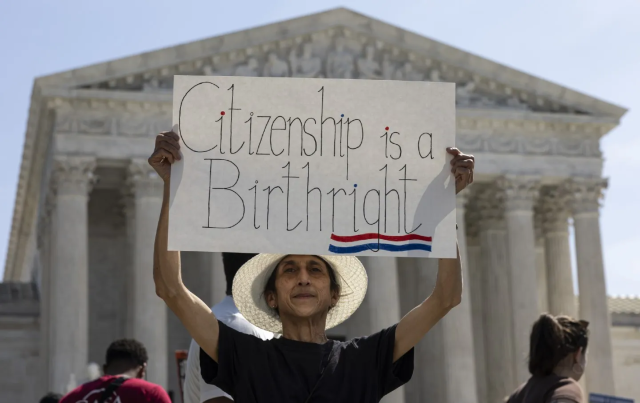
Supporters of birthright citizenship rally outside the US Supreme Court on April 1, 2026. (Mehmet Eser / Anadolu via Getty Images)
The battle over birthright citizenship is over. The war against birthright citizenship is just beginning.
That is the essential lesson of today’s Supreme Court ruling in Trump v. Barbara, the case involving Donald Trump’s Executive Order No. 14160, which denied citizenship to children born to temporary immigrants and children whose parents are in the country without authorization.
The ruling is a victory, to the extent that upholding a bedrock principle hard-coded into the Constitution for more than 150 years is what passes for a “win” these days. But the ruling was far closer than it should have been. There were a number of dissents, and when you read those dissents, the ruling looks less like the final word and more like the prologue to what will be a long and ugly attempt to write xenophobia and bigotry back into the Constitution.
The case hinged on two objections to Trump’s executive order: that it violated federal statute and that it violated the Citizenship Clause of the 14th Amendment.
On the statutory claim, Trump lost 6–3. Chief Justice John Roberts wrote for the majority, and his 30-page opinion (in a ruling that clocked in at 194 pages) was almost perfunctory. At the risk of oversimplifying it, Roberts said that birthright citizenship (as enshrined both in federal law and the Constitution) means what we’ve always thought it meant: that all children born here are citizens here. He was joined by justices Sonia Sotomayor, Elena Kagan, Ketanji Brown Jackson, and Amy Coney Barret. He was also joined, in part, by alleged attempted rapist Brett Kavanaugh.
Kavanaugh only joined Roberts’s interpretation of federal law. On the more important constitutional question—whether the Citizenship Clause of the 14th Amendment demands that all persons born in the United States are citizens—Kavanaugh split off, making the vote 5–4. In a concurrence, he said that the Citizenship Clause does not apply to children whose parents are living here in violation of US law. His view was echoed by dissents from justices Clarence Thomas, Samuel Alito, and Neil Gorsuch.
The fact that the foundational principle of American citizenship, something said clearly and plainly in the Constitution, survived by only the slimmest of majorities over the strenuous objections of two-thirds of the Republican supermajority should not be cause for celebration. It is a cause for deep concern. Trump tried to change the definition of citizenship by executive fiat in clear opposition to the text of the 14th Amendment, and he almost got away with it. This time. And we know there will almost certainly be a next time; the Supreme Court loves to give Trump multiple bites at the apple whenever he is trying to graft bigotry onto the Constitution.
By Elie Mystal