
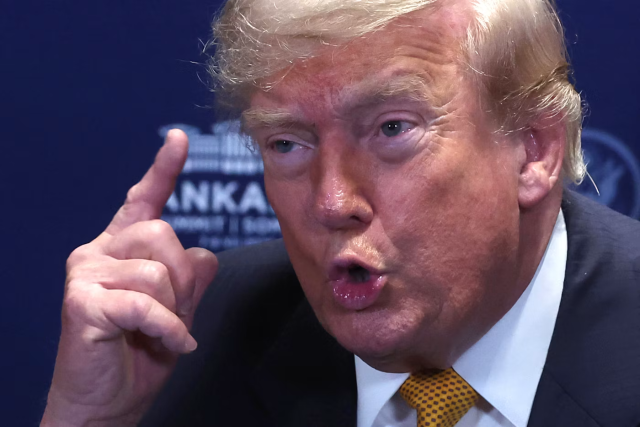
Donald Trump thinks he has a new way to force Republicans to pass voter suppression legislation in time for the midterms. In a late-night tirade, Trump demanded that Republicans pass the so-called SAVE Act by attaching it to a must-pass defense spending bill. This comes as Republicans are getting more nervous about losing the Senate this fall, and some reportedly fear that Trump is setting them up. If they don’t pass the SAVE Act, they fear he’ll blame them for any midterm fiasco that takes place.
We think it’s premature to rule out the possibility of Republicans actually passing this thing. It’s a high-stakes moment that’s passing largely under the radar. So we’re talking to congressional scholar Norm Ornstein, one of our go-to people for decoding the congressional GOP. Norm, nice to see you.
Norm Ornstein: Good to see you too, Greg.
Sargent: So Donald Trump and MAGA are pressuring Republicans to pass the SAVE Act, which is this disgusting piece of voter suppression legislation. It can’t pass the Senate, so Trump is demanding that Republicans end the filibuster to pass it, which they don’t want to do or can’t do.
Meanwhile, House Speaker Mike Johnson is looking for a way to pass something that he can call the SAVE Act to placate all the hardliners allied with Trump. Norm, what exactly is Mike Johnson trying to pass, and what’s he trying to pull off here?
Ornstein: So first let me note, Greg, that John Thune has been as loyal a leader to a president, and certainly to Donald Trump, as anyone could have wished. And now he’s taking all of this abuse. But for Mike Johnson—many of his members, and they’re of course in very real danger of losing the House—they’re talking, and he’s talking to Trump, about using every voter suppression measure possible.
But they really, really, really want this SAVE Act, because so many of the districts that are vulnerable to them are in blue states. Red states are going to do a lot, including a lot that’s already in the SAVE Act. Florida’s talking about passing their own version, Texas and others.
But he needs something, and the SAVE Act includes a whole series of measures that would limit votes, suppress votes, make it difficult for people to vote at a time when Republicans are worried about a surge in voting—requiring that everybody provide proof of citizenship.
And even if you’re registered, you have to go back to the office to re-register with that proof of citizenship, which has to be either a passport or passport card or a birth certificate—but not just any birth certificate. It has to be one that’s embossed, not a copy. And of course, as we know, if you are a woman who got married and changed your name, you have to jump through additional hoops.
Sargent: The SAVE Act, as Trump wants it to pass, would include both the proof of citizenship requirement and also basically an end to mail voting, among a bunch of other stuff as well.
What Mike Johnson seems to be trying to do is put aside the piece that would end mail voting, because Republicans who aren’t crazy actually know that they need mail voting for themselves as well. So Mike Johnson wants to put that aside and pass the proof of citizenship piece, correct?
Ornstein: Exactly so, Greg. And let’s note here that Mike Johnson has a couple of reasons for wanting to do this. He is desperate to get something done. The fact is, many of his own members—and it’s particularly true of Mike Lee in the Senate and a couple of the others—are agitating publicly for this over and over again. There is a fear on the part of Johnson and other House Republicans that if they don’t pass something that has the name “the SAVE Act” attached to it, it will demoralize a portion of their base, who will say, you’re not doing what you need to do. That’s one reason.
The other, as we’ve discussed, is suppressing what they believe will be votes for Democrats. And the proof of citizenship, which is a poll tax, which ought to be unconstitutional and illegal, is the core part of it. But he wants to take out the mail-in voting, not just because it can hurt Republicans a lot—they use mail-in voting plenty—but also because he needs to get something through and then blame the Senate. Because frankly, if Mike Johnson had to choose one house to go over to the Democrats, he of course would rather have it be the Senate.
Sargent: Right. And so Mike Johnson thinks that he can essentially have slightly more of a chance of passing a SAVE Act that doesn’t have the mail voting piece. So in this context, at 12:58 a.m., Trump unleashes a tirade on Truth Social, calling our military “the strongest and the hottest in the world” and so forth—never mind the Iran fiasco, which is ongoing.
Then Trump says this: “When Congress returns, we must pass Reconciliation 3.0. The SAVE America Act, paired with the full funding of our great Department of War, can be passed very quickly, ensuring that the United States of America stays FREE for generations to come.”
Norm, let’s break this up into two pieces. What exactly does Trump want here? It seems that he wants Republicans to attach as much of the SAVE Act as they can to defense funding and pass the entire thing via reconciliation, which would then be able to pass the Senate on a simple majority due to that process, correct?
Ornstein: That’s exactly what he’s trying to do. And he wants to make the defense bill, which normally would be handled separately, as part of a separate appropriations along with a separate authorization, folded into a third reconciliation bill.
They’ve already done two. It’s unprecedented, or close to it, to have a third one. But it’s basically blowing up norms and rules to try and jam this through, even though the rules make it clear that it’s not allowable.
Sargent: Why can’t Republicans end the filibuster? Is it just that they don’t have enough Republican votes to do that?
Ornstein: Look, one part of it is a belief that if they do this first, then Democrats are going to take advantage of it if and when they end up with majorities in the House and Senate and a president, and they will dismantle everything that Republicans have done—not just during the Trump era, but going back to previous Republican presidents.
Sargent: Right. But Norm, if Republicans wanted to end the filibuster, could they do it?
Ornstein: They could with a majority. But there’s another deeper reason why some Republicans don’t want to do this. They know that there are lots of things that would be deadly for them and the country, devastating, that they don’t want to do—crazy radical stuff, stuff that moves us even more towards a police state, stuff that could blow up their own economies and their own workforces.
And they’re able to avoid doing that by saying, we would have voted for it, but we don’t have 60 votes. So the filibuster actually gives a number of them who are not the crazy radical rightists—there are few who are—even if they all vote the same way, who understand that the filibuster gives them protection.
Sargent: Norm, let me underscore that just so people really get it. Republicans know that if the filibuster were done away with, all of a sudden they’d be able to pass whatever Trump and MAGA want with a simple majority in the Senate. And they don’t want that state of affairs, because that would fuck the country and fuck the Republican Party in essence. So keeping the filibuster for them is kind of like a way to crazy-proof themselves against Trump and MAGA, more or less, right?
Ornstein: That’s exactly right.
Sargent: If Mike Johnson were to send some version of the SAVE Act over to the Senate, can they pass it with reconciliation, or would the Senate parliamentarian kick that out?
Ornstein: There is no doubt that every part of the SAVE Act is inadmissible under budget reconciliation rules in the Senate. They have something called the Byrd Rule, which is named for Robert Byrd when he was the Senate leader. And it is basically that the fundamentals of everything in the budget reconciliation bill have to be fiscal. It has to involve spending and/or taxes. And it has to not add to the deficit or debt after a 10-year period. But they’ve always relied on what the parliamentarians said.
However, the way they’ve relaxed their rules in the past is through this kind of maneuver. The parliamentarian rules that this is out of order. Somebody appeals the ruling of the chair. A simple majority can overrule the chair.
And so what would happen here is, the parliamentarian would say, no SAVE Act, no portion of the SAVE Act, not allowable under the rules. Somebody—Tom Cotton, Mike Lee, any of the others—would appeal the ruling of the chair. Fifty Republicans would vote to overrule the chair, and then it would pass.
It would be wrong. It would be illegal under the Senate rules. What would stop it from being signed by the president? Nothing. What would stop it in the courts? There’s no way the courts would intervene.
So they can do this through the back door. But they also know that doing it that way is going to open up the floodgates for all kinds of actions that they would not like. And if they do it this way, then every radical, crazy Freedom Caucus right-wing proposal under the sun, they’re going to jam into reconciliation and use this as a precedent.
Sargent: And then overrule the chair. Well, I just want to move on to another thing. NBC had this really striking report on what’s going on inside the Republican Senate caucus. The report says, “Some Republican strategists worry the party’s chances of holding the Senate are dwindling.”
And the report also suggests Republicans are shocked and baffled that Trump keeps prioritizing the SAVE Act over showing that the party cares about costs, which is voters’ top issue. Republicans think, in short, that this is screwing them—Trump is screwing them, essentially.
One GOP operative says, “Poll after poll shows affordability is the top issue, but his mind is elsewhere.” Norm, you’ve been around a long time. Have you ever seen a GOP Senate caucus quite this angry with a Republican president?
Ornstein: No, I have not seen a Republican caucus in the Senate this angry with one of their own presidents. But let’s also keep in mind, Greg, that that anger, which is expressed for almost all of them privately—occasional exceptions—Thom Tillis talks a good game, and then they vote for what he wants.
Now, they may not do it in this case, because it cuts too close to home. But two things are involved here. They’re pissed because he’s putting pressure on them to do something they don’t want to do, and it’s a distraction, and it undermines their standing at home, because some of their own base voters are going to say these guys are disloyal—because they’re cultist voters. At the same time, they’re right that what people care about is first and foremost their own lives and affordability.
And it’s not just, let me note, that Trump is just talking about the SAVE Act. Look at some of the things he’s said recently. “They make up this word ‘affordability,’ those Democrats. There’s no such thing”—which does not resonate with their own voters, with working-class voters. And he said, we’ve got a war to fight, we can’t fund Medicare or Medicaid or education or housing or any of these other things.
And when they were able to pass a bipartisan housing bill to deal with a key component of affordability, he said, I’m not going to sign it—after promising that he would. The bait and switch. So he’s undermining them at every front. But it’s still a cult, Greg, and we cannot rule out that when he pushes hard, they’ll go along, because they’re afraid.
Sargent: Well, there’s another striking thing in the NBC report. Republicans say they fear Trump is setting them up to take the blame for midterm losses. One GOP senator says Trump “will blame it on us and the fact that we didn’t pass the SAVE Act.”
The senator adds: “He likes to dominate people, and he’s a bully, and he’s fucked things up as fast as he can, and there’s nothing anyone can do about it.”
Norm, that’s amazing stuff. Republicans created this guy every step of the way. He’s fucked them in every which way. His unpopularity is the reason that they’re cratering potentially this fall. And now they’re saying—now all of a sudden they’re angry at him? What do you make of that?
Ornstein: I think there’s frustration. And part of the frustration is that they’ve come to realize that the rash acts that he’s taken—this insane war with Iran and the way it’s playing out, the tariffs in and out and up and down, the inability to deal with major problems facing the country. The fact that—because he’s not just blown up green energy, he’s paying billions of taxpayer money to stop wind projects that are almost completed.
And as a result, we’re likely to have more energy shortages and stoppages during the worst summer weather, that will hurt them as well. There is a growing awareness that this monster that they’ve created is creating problems for them and not just for others.
You know, at the same time, they are unwilling to push back on the horrible things that ICE and the Border Patrol are doing. And what they’re realizing in states, including like Texas, is that the Hispanic votes that went to Republicans in 2024 are leaving them in substantial numbers, because of the policies that Trump is pursuing and their unwillingness to try and put a brake on any of them.
Sargent: A hundred percent. Well, to wrap this up: we’ve got Donald Trump demanding that they pass the SAVE Act, Republicans fearing that his obsession with the SAVE Act and refusal to focus on costs and everything else are putting them at risk. What’s going to happen?
There are several stages here where this could kind of fall apart, on liberals really. Number one, they could just end the filibuster—Republicans could end the filibuster and pass the SAVE Act. Number two, they could try to pass it via reconciliation, and if the parliamentarian throws it out, they could take the steps you outlined to overrule the parliamentarian. So is one of those things going to happen? Are they going to pass the SAVE Act, Norm?
Ornstein: I think there is a 40 percent chance that they will. And the reason, in the end, is—well, two reasons. One is the relentless pressure from Trump and the fear that by failing to do so, their own voters will turn against them. The second is the fear that they could lose the Senate, and they’ll do anything, including long-shot stuff, to make it happen.
Now, there’s one caveat I would offer out there. The Constitution has banned poll taxes. This goes back to the Jim Crow era, where Southern segregationists blocked African American votes—blocked poor people’s votes—by putting a poll tax. You had to pay to vote. And the Constitution says you can’t do that in federal elections. Law says you can’t do it in state and local elections.
Requiring a passport or an embossed birth certificate is a poll tax. It costs $170 to get a passport if you don’t have one. And you have to provide proof of citizenship. Every state has some kind of a fee for an official birth certificate. Many of them are not available. So it’s at least possible that that part of the SAVE Act could be blocked in the courts as unconstitutional—although this Supreme Court, God knows what they would do.
Sargent: Right. And that’s critical, because it looks like the mail piece won’t pass—the banning of vote by mail won’t pass, because Republicans want to keep that. Just to really clarify this: you think there’s a 40 percent chance that Republicans either end the filibuster or overrule the parliamentarian to pass the SAVE Act?
Ornstein: Yeah. And I think it’s far more likely that they would do it by overruling the parliamentarian, so that they could then claim, we didn’t take away the filibuster.
Sargent: Well, if that happens, Norm, all bets are off—but I really just don’t know whether that actually helps them. It could potentially help Democrats more. Norm Ornstein, thanks so much for coming on. That was a really, really great roadmap for us. We really appreciate it.
Ornstein: Always happy to do it with you, Greg.