
The Trump administration has proposed stripping private schools of their tax-exempt status if they consider race, furthering the administration’s intense pressure on institutions that have sought diversity in their classrooms.
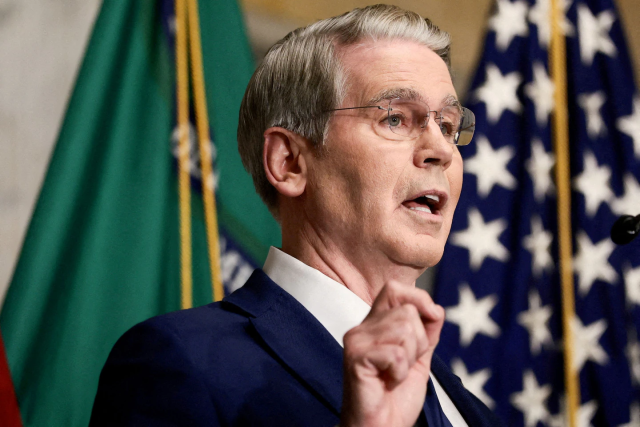
Treasury Secretary Scott Bessent last month. (Evelyn Hockstein/Reuters)
President Donald Trump’s administration has repeatedly targeted efforts to benefit Black and other racial-minority students, saying many such policies violate the law in the wake of a 2023 Supreme Court ruling banning the use of race-consciousadmissions. It recently has accused several medical schools of discriminating against White and Asian students in admissions, and has opened investigations into numerous universities.
The IRS and Treasury Department proposal announced Thursday would eliminate tax-exempt status for any private school that discriminates “on the basis of race, color, or national or ethnic origin in administration of its educational, admissions, scholarship, athletic, or other policies.”
The agencies estimate that if it takes effect, the rule could affect as many as 18,000 primary and secondary schools, colleges, universities, professional schools, and trade schools.
Spokespeople for Treasury, the IRS and the White House did not immediately respond to requests for comment.
Treasury Secretary Scott Bessent said in a written statement that the administration is ensuring that racial discrimination has no place in American education. “Schools rebranding race-based preferences as equitable, inclusive, or diversity-enhancing does not change their discriminatory nature,” he wrote. “Today’s Treasury and IRS proposed regulations establish a clear standard, and the institutions that continue to use discriminatory practices will no longer receive the benefits of federal tax-exempt status.”
Ted Mitchell, president of the American Council on Education — which represents nearly 1,600 colleges and other related groups — said that if the proposal took effect, it would be hugely impactful. “But it’s not going to come to pass.”
He said it has become a familiar script from the Trump administration: “Discover cudgel. Wave cudgel. Find violations of laws that don’t exist. Threaten retribution. Go to court. We’ve seen this over and over and over again.”
The weapon in this case is a provision in the tax code.
Federal law grants an exemption from taxes to organizations that operate exclusively for charitable and educational purposes.
Losing tax-exempt status could be devastating for institutions. Investment income that many colleges rely on to fund salaries and student financial aid would be subject to taxes. Schools could also have trouble raising money because charitable contributions would no longer be deductible for donors. They could no longer issue tax-exempt bonds to finance new buildings or other projects, and would instead need to obtain taxable debt at a higher interest rate.
“This is very serious,” said Philip Hackney, a professor at the University of Pittsburgh School of Law. “We’re not just talking colleges; it’s primary and secondary private schools. Let’s assume that 30 percent of their income is from charitable contributions; they could take a real financial hit if they lost their status.”
The National Association of Independent Schools, a nonprofit membership organization representing more than 1,600 independent, private K-12 schools across the U.S. and internationally, said it is assessing the implications of the tax proposal. Because the regulations are still at the proposal stage, and are subject to the federal rulemaking process, the association said significant questions remain regarding their scope, interpretation and implementation.
Supreme Court rulings have held that tax-exempt status is dependent on compliance with “fundamental national public policy,” including the prohibition against racial discrimination.
In 1983, the court ruled that Bob Jones University and the Goldsboro Christian Schools in North Carolina were not entitled to tax-exempt status because they practiced racial discrimination — the university prohibited interracial dating and marriage, and the schools did not admit Black students.
Mitchell said the administration is using an untested area of law with its expansive interpretation of what the 2023 Supreme Court ruling on affirmative action requires. He said after that decision, colleges across the country changed their admissions practices and other policies to ensure compliance with the law.
Luís Calderón Gómez, an associate professor at Cardozo School of Law, said the administration’s tax proposal is at odds with legal precedent and relies on a broad interpretation of the affirmative-action ruling that may not hold up in court.
“This is quite an expansive assertion of power from the IRS,” Calderón Gómez said. “I’d be surprised if there aren’t legal challenges to this rule.”
In 2025, soon after Trump took office, the Education Department’s Office for Civil Rights issued a guidance letter to school officials that threatened to deny federal funding to any college or school that considered race in hiring, scholarships, discipline or other areas. The agency later asked for written certification that schools were complying with federal civil rights law, including by avoiding diversity, equity and inclusion practices. The “Dear Colleague” letter was challenged by three lawsuits and blocked.
Conservative groups and lawmakers have praised the administration’s efforts to undo decades of policies and practices promoting diversity, equity and inclusion.
“Taxpayers are fed up with subsidizing race-based discrimination, and they are sick of being forced to pay for left-wing indoctrination at institutions that pretend to be neutral academic endeavors,” said Corey DeAngelis, a research fellow at the Heritage Foundation, a conservative think tank.
Andrew Gillen, a research fellow at the Center for Educational Freedom at the Cato Institute, a libertarian think tank, said the proposal has a worthy goal but is the wrong tactic. He said Title VI of the Civil Rights Act, which bars discrimination on the basis of race or national origin, has a superior process for identifying and punishing discrimination.
The IRS, he said, lacks the experience and authority of the Justice Department and the Education Department, which have investigated racial discrimination for decades. Gillen said the Civil Rights Act is also more permanent and predictable than regulation that could be overturned by the next administration or the courts.
“If the administration wants to add another punishment for universities that racially discriminate,” Gillen said, “it should pass a law adding the punishment to the existing list of punishments under the Civil Rights Act and follow the process of the Civil Rights Act to ensure only the guilty are punished.”
Others raised broader concerns.
The Thursday proposal fits into an overall pattern of weaponizing civil rights law in ways that are harming education and diminishing opportunities, particularly for students of color, said Michael Pillera, director of the Educational Opportunities Project at the Lawyers’ Committee for Civil Rights Under Law, an advocacy group. The proposal is based on “upside-down, harmful, unsupported interpretations of civil rights law,” he said, and the administration’s efforts are having a tremendous chilling effect. “That’s why it’s important to be clear that a lot of the past efforts have been focused on asserting things are law that are not law.”
Two Democrats in Congress, Reps. Lloyd Doggett (Texas) and Terri Sewell (Alabama), introduced a bill Thursday designed to prevent the IRS from stripping a nonprofit of its tax-exempt status without evidence and without a fair process.
“The IRS should never be a weapon to punish a President’s political enemies,” Doggett said in a news release.
The Trump administration proposal still would allow schools to help disadvantaged students in admission or financial aid using race-neutral criteria such as family income, hardship or academic achievement.
The proposal, which is subject to a lengthy public-comment period, could go into effect in May.
correctionA previous version of this article gave an incorrect number of schools that the National Association of Independent Schools represents, based on information from a spokesman. It represents more than 1,600 schools, not 1,900.
clarificationThis article has been revised to include primary schools, professional schools and trade schools as among the 18,000 educational institutions that could be affected.
Susan Svrluga covers national higher education for The Washington Post. follow on X@SusanSvrluga
Danielle Douglas-Gabriel covers the economics of higher education, writing about the financial policies that determine a student's access to education and ability to complete a credential. follow on X@DaniDougPost